Whuffie
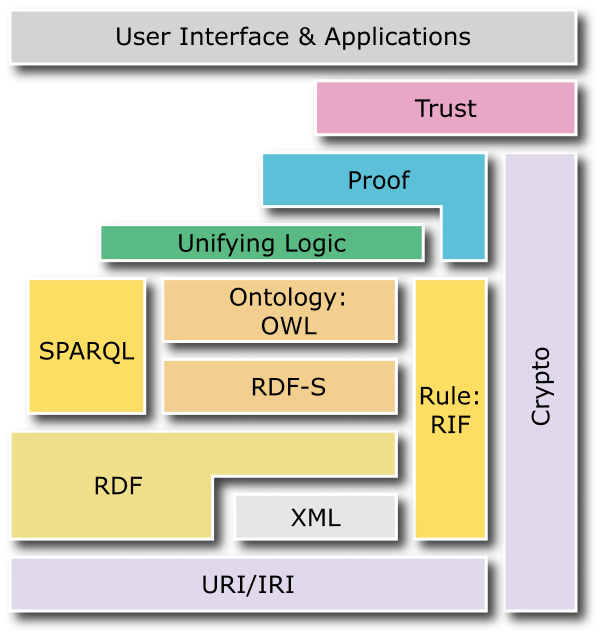
Yet again I've heard about this issue of trust on the Semantic Web. It's starting to become more important, and I guess I should have predicted the timing.TBL's slowly-evolving image of the Semantic Web stack has always included Trust up near the top. I remember when we first started doing this, we were seeing all these higher layers which were entirely theoretical. But in the last couple of years, some real implementations have been coming out at all these levels. We may have some way to go before it's all stable and finalized, but now there are several usable implementations offering real functionality at almost every level. So it's to be expected that Trust needs to be addressed now.
Like the other layers before it, the issue of trust is currently being addressed by several vendors and researchers in a tentative way (a search will show lots of proposals and a few implementations). I'm sure the implementors will say that their solutions are more than tentative, and I don't want to disparage anyone's hard work, but I haven't seen anything that's been popularly received yet. However, in typical Web 2.0 fashion it seems that some notions of trust are bubbling to the surface all by themselves.
Social networking sites have major issues with trust. Note: I'm going to avoid the issue of physical safety, such as minors talking to pedophiles, or young women talking to predatory men, etc. These are issues of security and trust that really need to be controlled well, and I'm going to leave them to the experts.
Once people start linking up to one another on sites like Facebook, then issues of social trust start to come to the fore. One one hand, it isn't that big a deal, since it's only social information, and hence the risk to finances, property, etc. is not really there, leaving the sites open to experimentation, or often doing nothing at all. On the other hand things of social value, like reputation, social acceptance, and self esteem are all on the line.
Since social networking sites concentrate so heavily on teenagers and young adults, then things of social value are all extremely important issues. In fact, in many cases these social risks are more important to teenagers and young adults than security of finances and property (usually because they HAVE no finances and property of note - well, that's how it was for me and all my friends at that age). So what happens when there's a real need for social trust, and no mechanism built to deal with it? Well, like many features of Web 2.0, something tends to emerge on its own.
Most sites have ways in which popularity can be measured. The first I ever saw this was moderation (and meta-moderation) on Slashdot. Now most sites have a mechanism to adding votes, or comments, or just plain old links, to popular content. The result is that people tend to bubble up to the top if they have something to say that other people care about. Anyone without anything useful to contribute drops to the bottom. Of course, this is fickle, but in the world of social perceptions, popularity is king whether you choose to recognize it or not.
What happens when you first go to sites like YouTube? Unless you're there to see a specific video, you browse through the most popular stuff. (Actually, I prefer Vimeo as it is about raw social interaction, while YouTube has so much commercial content and even the amateur content usually has some "production" effort behind it). But regardless of whether you're browsing Vimeo, Flickr, or Facebook, the pages you look at first are the ones that others already endorsed in some way.
To me this looks a lot like a precursor to Whuffie. This isn't the only element of Doctorow's book which we are starting to see. Sites like Twitter are starting to connect groups of people all the time, Google, and Wikipedia are available on cell phones 24/7, and the phones are capable of managing video, video, and text with increasing ease. Not to mention Josh Spears observation that young people (and others) today feel semi-naked without their cell phone. While Doctorow's book has everyone implanted with this technology, he refers back to a time when everyone used hand-held devices, much like what we're starting to see (note the buzz around the consumer centered iPhone, vs. the ho-hum responses to upcoming business phones). With each year Doctorow is sounding more and more visionary. This is happening despite some people on the fringes actively striving toward a "Bitchun Society" rather than because of it.
I don't spend much time in social networking sites, but the more I do, the more I think that the problem of trust is going to emerge from that space, almost because it has to rather than because someone designs a system of trust.
Thanks to David for finding the latest version of the Semantic Web Layer Cake. There are so many versions now that I kept finding old ones instead.